Introduction
Every January, the digital marketing world floods with trend predictions. Most recycle last year’s advice with updated statistics.
This isn’t that article.
At ASTOUNDZ, we work with service businesses every day — plumbers, attorneys, HVAC contractors, IT companies, medical practices. The trends that matter to a Houston law firm or a Phoenix roofing company look nothing like the trends dominating enterprise marketing conversations.
TikTok Shop hitting $20 billion? Fascinating — but irrelevant if you’re a family-owned electrical contractor.
AR try-on features revolutionizing retail? Great for fashion brands, but your emergency plumber isn’t building virtual showrooms.
This guide focuses on what actually moves the needle for service businesses in 2026. Every trend here has been validated against industry research, tested against real client results, and filtered through one question: Does this help businesses connect with customers who need their services?
Trend 1: Generic AI Content Fails — Strategic AI Content Wins
The AI content gold rush is officially over.

Why the disillusionment? Because most businesses approached AI content the same way: dump a generic prompt into ChatGPT, copy the output, publish. The result is an internet flooded with content that sounds exactly the same — polished, generic, forgettable.
Search engines have noticed. Google’s March 2024 core update specifically targeted “scaled content abuse” — their term for AI-generated content farms. Sites that built their entire strategy around mass-producing AI articles saw traffic drops of 40-60% overnight.
But businesses using AI strategically are seeing the opposite result.
The difference comes down to one word: voice.
One approach produces forgettable content that sounds like everyone else. The other amplifies what makes your business actually different.
Strategic AI use looks like this:
- Training AI on your specific brand voice, customer language, and service offerings
- Using AI to research and outline while humans write the final draft
- Letting AI handle data analysis while your team adds expertise and local knowledge
- Building custom workflows that incorporate your actual client questions and concerns
A personal injury law firm that feeds AI their consultation transcripts, case outcomes, and client testimonials creates content that sounds like them — not like every other law firm using the same generic prompts.
What this means for your business: AI isn’t going anywhere. The opportunity is using it to strengthen your authentic voice rather than replacing it. The businesses winning in 2026 aren’t avoiding AI — they’re using it to do more of what already makes them unique.
Trend 2: GEO Expands SEO — It Doesn’t Replace It
That take is wrong.
Don’t abandon your SEO strategy to chase GEO. Here’s what’s actually happening: AI-powered search features like Google’s AI Overviews and ChatGPT’s browsing capabilities are becoming additional discovery channels. They’re not replacing traditional search — they’re expanding it.
The data confirms this. According to research from Profound on B2B buying behavior, AI-assisted research influenced 9.7% of total company revenue in 2024. Significant — but 90.3% of revenue still flows through traditional channels. AI-influenced purchases also showed 32% higher close rates despite shorter consideration windows.
More importantly, AI answers don’t appear from nowhere. They pull from indexed web content. If your website doesn’t rank for traditional search, AI tools have nothing to cite. Semrush’s analysis of AI Overview citations shows 84% of cited sources also rank in the top 10 organic results.
The practical reality: strong traditional SEO is now prerequisite for GEO success.
What’s changing is the type of content that performs well. AI systems favor:
- Direct answers to specific questions
- Structured data and clear formatting
- Authoritative sources with demonstrated expertise
- Content that cites credible references
For service businesses, this actually simplifies things. The content marketing you should have been creating all along — helpful, specific, expertise-driven — is exactly what both traditional search and AI systems reward.
What this means for your business: Enhance your existing content with clearer structure, better answers to specific questions, and stronger expertise signals. If you’re already creating quality content, you’re already doing GEO.
Trend 3: Content Ecosystems Replace Random Blog Posts

Search engines now evaluate topical authority — your demonstrated expertise across an entire subject area, not just individual keywords. A law firm that publishes one article about car accidents, another about slip-and-falls, and another about medical malpractice without any strategic connection signals scattered expertise rather than deep knowledge.
The shift toward content ecosystems changes everything.
A content ecosystem is an interconnected network of pages that collectively demonstrate comprehensive expertise on a topic. At its core is a pillar page — a comprehensive resource on a broad topic — surrounded by cluster content that explores specific aspects in depth, all strategically linked together.
For a personal injury law firm, that ecosystem might look like:
- Pillar page: “Complete Guide to Personal Injury Claims in Texas”
- Cluster content: Specific articles on car accidents, truck accidents, motorcycle accidents, pedestrian accidents, workplace injuries, medical malpractice, premises liability — each linking back to the pillar and to each other where relevant
- Supporting content: FAQ pages, case result summaries, client testimonials, local court information
This architecture does three things simultaneously:
- Signals topical authority to search engines
- Keeps visitors engaged longer by providing natural next steps
- Builds a cohesive brand narrative rather than disconnected content pieces
The strategic linking within content ecosystems transforms random posts into a unified authority signal. When your car accident page links to your truck accident page links to your how-damages-are-calculated page, search engines see a web of expertise rather than isolated articles.
This is fundamentally about brand authority. Every piece of content should reinforce who you are, what you stand for, and why someone should trust you. Random blog posts can’t do that. A thoughtfully constructed ecosystem tells a complete story about your expertise.
What this means for your business: Audit your existing content. Map what you have to topic clusters. Identify gaps. Then build systematically rather than randomly. One well-planned content ecosystem outperforms dozens of disconnected blog posts.
Trend 4: Brand Presence Replaces Link Schemes
Links still matter. But the value equation has fundamentally shifted. A comprehensive internet marketing approach now prioritizes consistent brand presence across platforms your customers actually use over collecting links from random directories.
The data supports this shift. According to Gitnux’s 2024 omnichannel marketing statistics, businesses with consistent presence across 3+ channels see 250% higher engagement rates than single-channel businesses. Customer retention tells an even more dramatic story: 89% for omnichannel versus 33% for single-channel approaches.
For service businesses, “omnichannel” doesn’t mean being everywhere. It means being consistently present where your customers look:
- Google Business Profile (absolutely non-negotiable)
- Your website with consistent NAP (Name, Address, Phone) information
- Industry-specific directories that customers actually use
- Review platforms relevant to your service area
- Social profiles you can actually maintain
The key word is consistent. Same business name. Same phone number. Same address format. Same brand voice. Same visual identity. Every inconsistency creates friction for both search engines and customers.
Brand presence also means showing up in conversations about your industry. When someone asks on a local Facebook group for plumbing recommendations, is your company mentioned? When there’s a Reddit thread about finding a good divorce attorney in your city, are you part of the conversation — not through self-promotion, but through genuine community presence?
People invest in people they trust. That trust doesn’t come from a link on some random directory. It comes from showing up consistently, providing real value, and building recognition over time.
What this means for your business: Audit your brand presence across all platforms. Fix inconsistencies. Focus on depth over breadth — better to maintain excellent presence on five platforms than mediocre presence on twenty. Build real relationships in your community, online and off.
Trend 5: Your Google Business Profile Is Your Home Away From Home
According to BrightLocal’s 2025 Local Consumer Review Survey, 83% of consumers use Google to read reviews for local businesses, and 89% expect business owners to respond to both positive and negative reviews. Perhaps most telling: 74% of consumers check at least two review sites before making a purchase decision. When someone searches “plumber near me” or “best divorce attorney in Houston,” your GBP is often the first — and sometimes only — touchpoint.
Google’s local algorithm updates in 2024-2025 have made GBP even more central:
- AI-powered business profiles that automatically generate descriptions from reviews and photos
- Expanded attribute options for showcasing specific services and business characteristics
- Enhanced review response features that reward active engagement
- Nested department listings for multi-service businesses
That last point deserves attention. If your business offers multiple distinct services — like a home services company doing plumbing, HVAC, and electrical — nested department listings let you create separate GBP presences for each service line while maintaining connection to your parent business. This dramatically improves visibility for specific service searches.
The review landscape is also shifting. Google’s 2024 policy updates now allow pseudonymous reviews in certain categories, affecting both review volume and authenticity signals. Businesses that actively manage their review presence — responding thoughtfully to both positive and negative feedback — see measurably better local pack rankings.
What this means for your business: Treat your GBP with the same strategic attention you give your website. Complete every field. Add photos regularly. Respond to every review. Post updates weekly. Select the right Google Business categories for maximum visibility. If you offer multiple services, explore whether nested department listings make sense for your business structure. Professional Google Business Profile management ensures nothing falls through the cracks.
Trend 6: Your Face Is Your Best Marketing Asset
Authenticity is outperforming polish.
Hootsuite’s 2024 Social Media Trends Report found that user-generated content and authentic behind-the-scenes material consistently outperforms professionally produced content in engagement. People can spot manufactured content from miles away, and they’re choosing real over perfect.
For service businesses, this is liberating. You don’t need a production studio. You need:
- The owner explaining why they started the business
- Technicians showing how they solve common problems
- Office staff sharing what makes your company culture different
- Real customers telling real stories (with permission)
Video has become the dominant format. Wyzowl’s 2026 State of Video Marketing Report shows 91% of businesses now use video as a marketing tool, with 82% saying video has directly helped increase sales.
Short-form video — under 60 seconds — works best for discovery. Longer content works for viewers who already know you and want to go deeper. Personality-driven content builds trust faster than any amount of polished brand messaging.
A 30-second video of your lead technician explaining a common HVAC problem builds more trust than a thousand-dollar professionally written service page. It lets potential customers see who’ll actually show up at their door.
This isn’t about becoming a social media star. It’s about recognizing that people want to know who they’re trusting with their home, their legal matter, or their business technology.
What this means for your business: Start small. A smartphone and decent lighting are enough. Film your team doing what they do. Answer common customer questions on camera. Share the human side of your business. It doesn’t need to be perfect — it just needs to be genuinely you.
Trend 7: Zero-Click Search Isn’t a Threat — It’s a Quality Filter

But the panic misses the point.
Zero-click searches serve two purposes:
- Simple queries that don’t need websites — “What time is it in Tokyo?” doesn’t require visiting 10 web pages.
- Research and comparison phases — People gathering information before they’re ready to engage.
For service businesses, the searches that matter most — “emergency plumber near me,” “best personal injury lawyer Houston,” “IT support for small business” — still generate clicks. These high-intent, ready-to-act searches drive actual business.
What’s changing is the middle of the funnel. People conduct more research within search results before clicking. This means your visibility in those results — through featured snippets, knowledge panels, local packs, and AI Overviews — shapes perception even before someone reaches your site.
The business implications:
- Optimize for featured snippets — Clear, direct answers to common questions
- Maintain strong local pack presence — GBP optimization becomes even more critical
- Focus on quality over quantity — The traffic that reaches your site is increasingly qualified
When someone does click through after AI-assisted research, they’re more ready to buy.
What this means for your business: Stop measuring success purely by website traffic. Track conversions, calls, and form submissions. A hundred highly-qualified visitors who convert beat a thousand random visitors who bounce. Zero-click search is filtering out the tire-kickers — let it.
Trend 8: Hyperlocal Gets Genuinely Local — And Voice-Activated
Google’s local algorithms now incorporate:
- Proximity signals with much higher precision — not just city, but neighborhood
- Real-time factors like traffic patterns and business hours
- User behavior data showing which businesses people actually engage with
- Review sentiment beyond just star ratings
For service businesses, this means local SEO strategy must extend beyond city-level optimization. Neighborhood-specific content, location-specific service pages, and genuine local community involvement all contribute to hyperlocal visibility.
But here’s the trend many businesses are missing: voice search is amplifying hyperlocal even further.
According to ThinkWithGoogle research, 76% of voice search queries have local intent. When someone asks their phone “Where’s a good plumber near me?” or “Who does AC repair in Cypress?”, they’re expressing immediate, location-specific need.
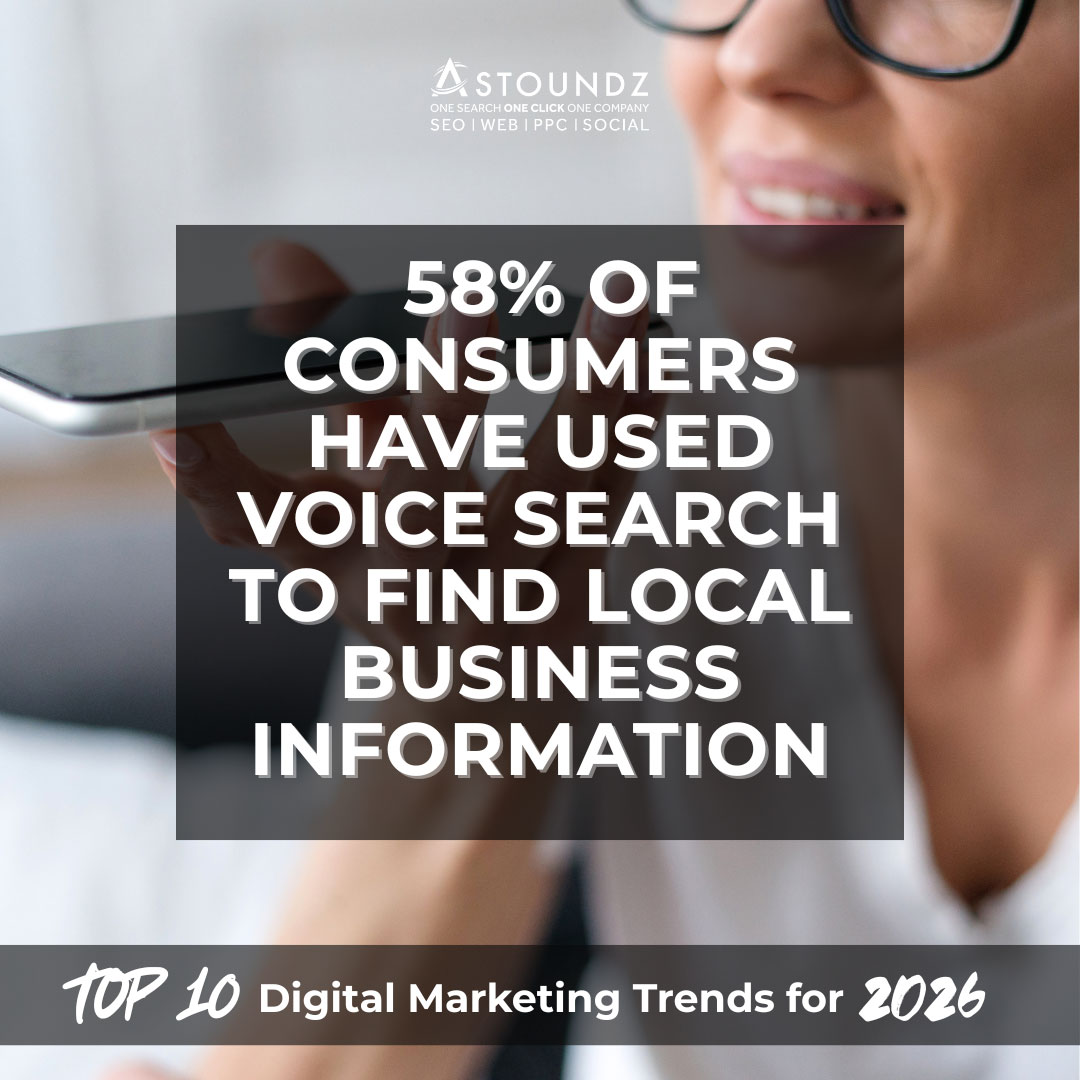
The numbers are substantial: Statista data shows 88.8 million Americans use voice assistants, driving over $2 billion in voice commerce. BrightLocal research confirms 58% of consumers have used voice search to find local business information.
Voice search queries differ from typed searches:
- They’re longer and more conversational
- They often include specific modifiers (“open now,” “emergency,” “near me”)
- They expect immediate, actionable answers
Voice assistants pull answers from the same sources that power visual search results. Businesses with complete, accurate, well-structured local presence show up in voice results.
What this means for your business: Build location-specific content for the neighborhoods you serve. Participate in local events and organizations — not for the links, but for the genuine local signals. Ensure your GBP hours are accurate (voice assistants check), your phone number is prominent (voice search often triggers calls), and your content answers questions the way people actually ask them out loud.
Trend 9: Your Customer List Becomes Your Most Valuable Asset

Meanwhile, privacy regulations continue expanding. GDPR enforcement has intensified. State-level privacy laws have passed in California, Virginia, Colorado, Connecticut, Utah, and more, with additional states following.
For marketers who’ve relied on pixel-based retargeting and third-party data, this is a crisis. For businesses who’ve built direct customer relationships, it’s an opportunity.
First-party data — information customers voluntarily share with you directly — becomes the foundation of effective marketing:
- Email subscriber lists
- Customer databases with service history
- Phone numbers with consent for communication
- Account preferences and stated interests
This data isn’t subject to third-party cookie restrictions. It represents genuine relationships rather than surveillance.
The practical implications:
- Build email capture into every customer touchpoint — Quote requests, service completion, follow-ups
- Create value exchanges for information — Useful guides, maintenance reminders, exclusive offers
- Maintain clean, organized customer databases — The asset is only valuable if you can use it
- Respect the relationship — First-party data comes with implicit trust; abuse it and you lose it
Businesses that invested in CRM systems and email marketing infrastructure for years are now positioned for competitive advantage. Those who relied entirely on platform advertising are scrambling.
What this means for your business: Prioritize email capture. Implement a CRM if you haven’t already. Create a systematic follow-up process that turns one-time customers into repeat relationships. Your customer list, properly maintained, is worth more than any amount of platform advertising spend.
Trend 10: Revenue Is the Only Metric That Matters

None of these pay the bills.
The marketing measurement conversation is finally maturing. Attribution models are getting more sophisticated. Media Mix Modeling (MMM) — a statistical approach that evaluates marketing channel contribution to business outcomes — is making a comeback after years of being overshadowed by digital attribution.
Why? Because digital attribution has fundamental blind spots:
- It can’t track word-of-mouth referrals
- It struggles with multi-touch, multi-device journeys
- Privacy changes have made tracking increasingly unreliable
- It inherently favors last-click channels over awareness-building
MMM addresses these gaps by analyzing correlation between marketing activities and business outcomes at the aggregate level. It’s not perfect, but it’s more honest about what marketing actually drives.
For service businesses, this means shifting measurement focus:
- Revenue generated — Actual dollars in the door attributable to marketing efforts
- Cost per acquisition — What you spend to get a customer, fully loaded
- Customer lifetime value — What that customer is worth over the entire relationship
- Lead quality — Conversion rates from inquiry to customer
A marketing report showing traffic increases and ranking improvements without corresponding revenue impact is a vanity report. A marketing report showing cost-per-customer-acquired decreasing while revenue increases is actionable.
What this means for your business: Demand revenue attribution from any marketing partner. Set up proper tracking from inquiry to closed sale. Make business decisions based on what makes money, not what makes charts look impressive.
What This All Means Together
These ten trends share a common thread: the era of gaming algorithms is ending, replaced by the era of earning attention through genuine value.
Generic AI content loses to strategic, voice-driven content. Link schemes lose to authentic brand presence. Vanity metrics lose to revenue accountability.
Anonymous marketing loses to putting real faces and real expertise in front of real customers.
For service businesses, this is good news. You don’t need the biggest budget or the most sophisticated technology. You need:
- Clear expertise in what you do
- Consistent presence where your customers look
- Authentic communication that sounds like you, not like everyone else
- Measurement focused on what actually grows your business
The businesses that thrive in 2026 won’t be the ones chasing every new tactic. They’ll be the ones doing the fundamentals well, consistently, while adapting to how customers actually search and decide.
At ASTOUNDZ, we’ve built our entire approach around this principle. Real results for real businesses, measured by what matters — revenue, customers, and growth.
The trends will keep changing. The fundamentals won’t.
Ready to Put These Trends Into Action?
If you’re ready to move beyond trend-watching and into implementation, we specialize in local SEO, national SEO, Google Business Profile optimization, and content marketing that deliver measurable results.
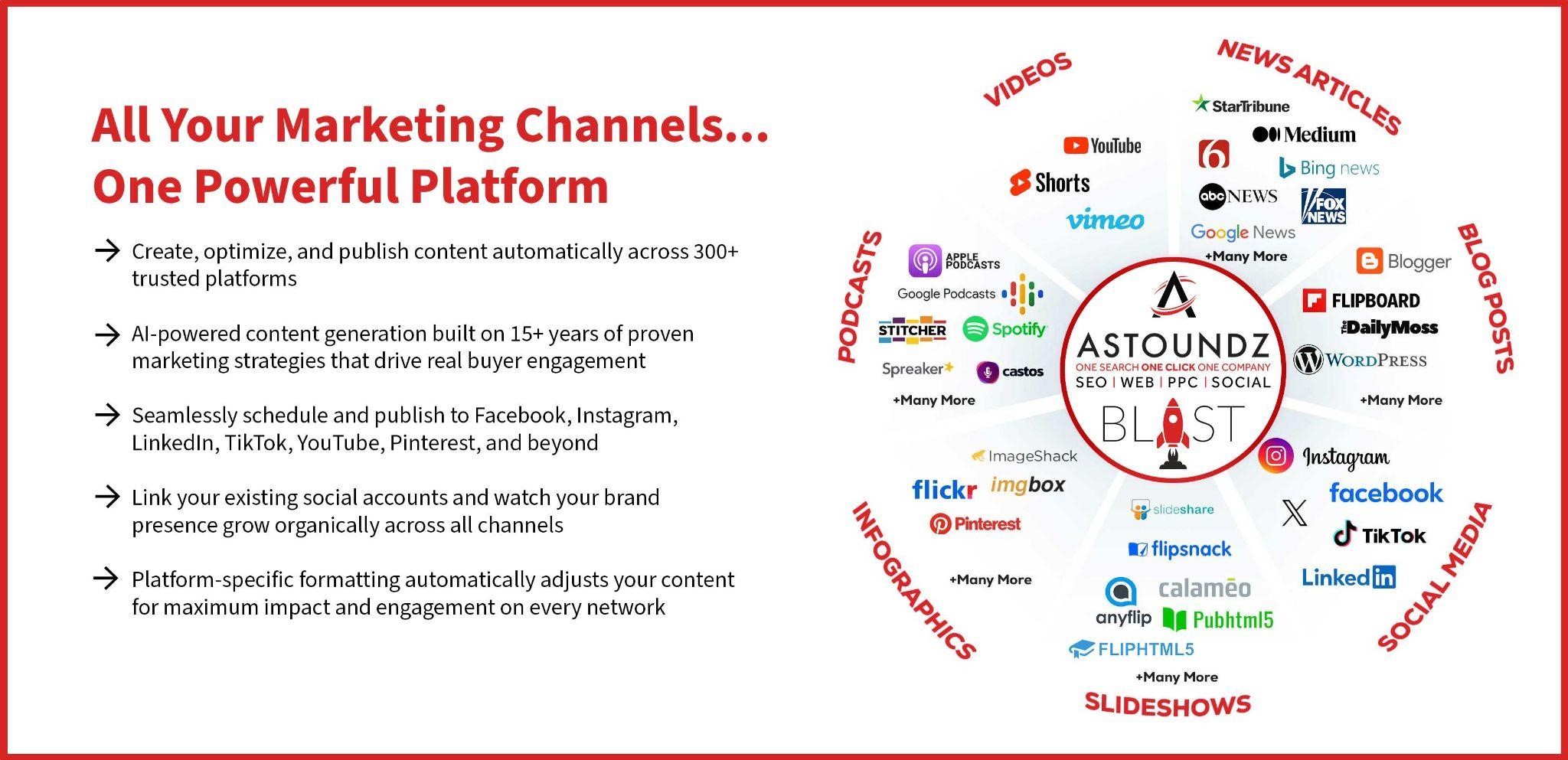
Introducing ASTOUNDZ Blast
All your marketing channels, one platform. ASTOUNDZ Blast creates, optimizes, and publishes content automatically across 300+ trusted platforms — news sites, blogs, YouTube, podcasts, social media, infographics, and slideshows. AI-powered content generation built on 15+ years of proven strategies. Platform-specific formatting for maximum impact on every network.
One topic. 300+ platforms. Real organic growth.
Contact us to learn more.
About the Author
Tatiana Schallert is an Integrated Marketing Expert at ASTOUNDZ, specializing in content, brand voice, and strategy. With years of experience building audiences across digital and creative platforms, she believes authentic voice beats polished templates every time — because the best marketing uncovers the story that’s already there. Based in Houston, she helps businesses sound like themselves, not like everyone else.